Community grounds / An Australian proposal
A place to land.
Room to move.
Shared places, homes on wheels and civics infrastructure that give people more room to rebuild their lives—and communities more capacity to thrive.
Explore community groundsConcept notes · Initial draft for discussion
From “How am I going to survive today?”
to “What am I going to do today?”
One strategy. Three connected parts.
Start with a place. Build the support around it.Community grounds
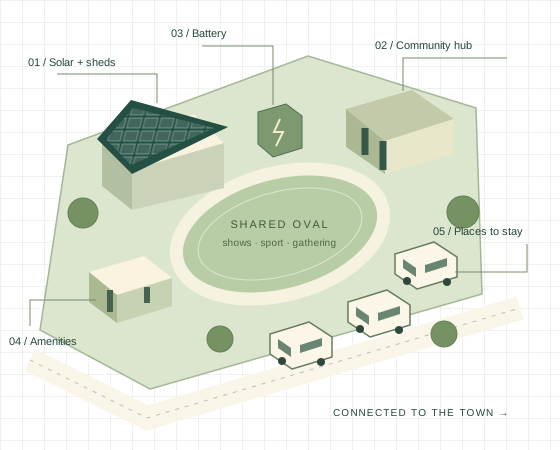
Establish community grounds—utilising suitable regional showgrounds and public spaces—with amenities, energy, connectivity and spaces to work on things together.
Explore the shared place ↗The Walkabout Strategy
Develop practical support to obtain, finance and maintain a second-hand home on wheels, with a suitable tow vehicle where needed.
Explore the personal pathway ↗Civics & digital infrastructure
Connect local energy, edge databoxes and open tools to empower community-led civics activities.
Explore the wider network ↗Embracing the Solarpunk vision
Radical optimism · Energy democracy · Community resilienceThe Solarpunk movement is a radically optimistic philosophy that envisions a sustainable, egalitarian future. It rejects climate doomerism, advocating instead for a world where humanity, nature, and technology co-exist in peaceful harmony. All enduring societies depend upon social foundations provided on a non-exploitative, usury-free basis.
“Solarpunk acts as a future imaginary to subvert climate fatalism, prioritising energy democracy, mutual resilience, and non-exploitative social foundations with community-oriented optimism.”
By championing decentralisation, renewable energy, and cooperative community strength, the Solarpunk ethos underpins everything we are building—redefining transitional infrastructure and securing fundamental rights to privacy, personal autonomy, and informational self-determination for all participants.
| Community Objective | Solarpunk Principle | Tangible Deployment |
|---|---|---|
| Asset Creation & Autonomy | Non-exploitative social foundations | All societies depend upon social foundations provided on a peaceful, non-exploitative (usury-free) basis. Tailored pathways and maintenance hubs for second-hand ‘homes on wheels’ build real personal assets and autonomy rather than compounding crisis debt or perpetual subsidies. |
| Clean Energy & Resilience | Eco-Technological Harmony | Commercial-scale solar, battery storage, and islandable microgrids at regional community grounds. |
| Informational Self-Determination & Local AI | Individual autonomy & decentralisation | W3C Solid-compatible portable data pods, offline-first edge controllers (Solid-CSS-Databox ↗), and community AI hubs—leveraging open standards that enable interoperability across systems created with various technologies. |
A secure base can open up choices.
The intended pathway—not a proven outcomeA suitable mobile home and a ground with the everyday essentials.
Understand the full weekly budget, repairs and available support.
Study, work, care for family, share a skill or take time to recover.
Stay where permitted, travel, relocate for work or move into another home. The journey out ↗
Life changes. People need options.
The initiative supports people navigating major life transitions: recovering from financial setbacks or relationship breakdown, caring for family, returning from defence service, studying, or establishing independent livelihoods.
It also includes travellers, remote workers and people who can cover their own costs but want an autonomous, sustainable way to live. Participation is not defined by poverty or by a single bureaucratic label.
A mobile home will not suit everyone. This proposal expands people's choices alongside permanent housing and specialist support, with suitability and access worked out through regional demonstration sites.